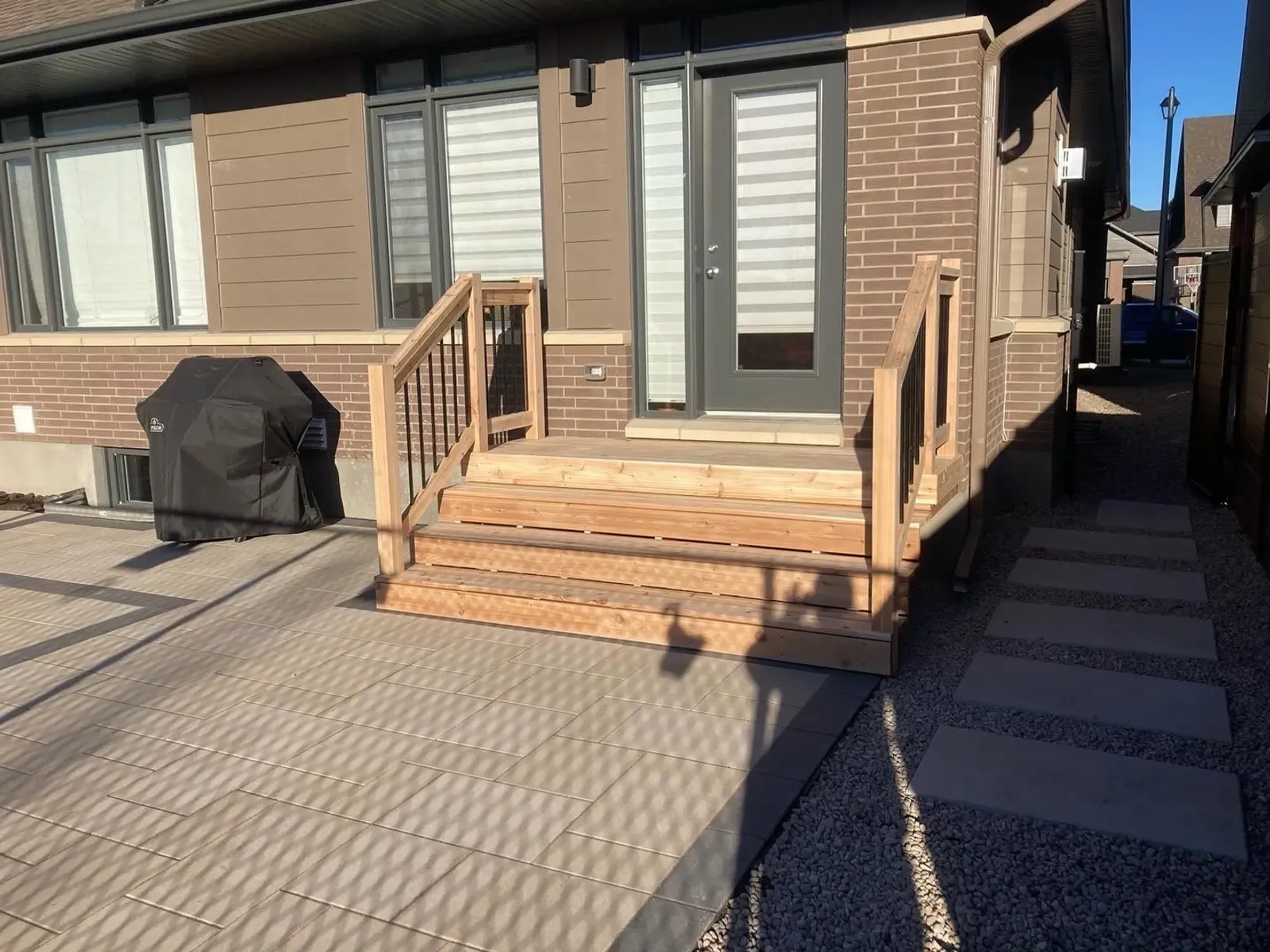
Close a deck up after the leaves come down and before the snow settles. In Ottawa that gives you a few weeks in October and early November, and the weather record shows how quickly they run out.
Here is the order to work in: what to clear, what to wash, what to check, what to leave alone. Where the answer depends on what your deck is made of, it’s marked.
When does the window close
Environment and Climate Change Canada publishes climate normals for Ottawa, and the current set covers 1991 to 2020. At the airport station the overnight low reaches 0 degrees Celsius or colder on about 7 days in October. In November that rises to about 20 days, and in December it is about 29.
Snow follows the same slope. The airport averages about 3 centimetres of snow in October, 21 centimetres in November and 50 centimetres in December.
The average daily temperature is 8.2 degrees Celsius in October and 1.7 degrees Celsius in November.
So October is the working month. By the second half of November, a cold night and a dusting of snow are both ordinary, and you’d be washing a deck that can’t dry. Pick a dry weekend in October and do the whole job in one go.
Trex, a composite decking maker, gives the same timing advice. Its winter guide says preventive measures are best done after leaves fall but before snow does.
What should you clear first
Start with everything that sits on the boards. Carry in the cushions, the planters and the small tables. Trex says to cover any outdoor furniture you plan to leave on the deck, so you aren’t cleaning it when warm weather comes back.
Then sweep. The same Trex guide says to sweep off leaves and other reminders of fall, so you avoid cleaning the residue they leave behind.
Do the gaps between the boards too. A putty knife or a stiff piece of wire pulls out the packed leaves and grit that hold water against the wood. Do the same along the house wall and around the railing posts, where debris gathers.
If you can get a flashlight under the deck, look there as well. You’re checking for anything that has drifted in and could hold moisture, and for any footing that has shifted over the summer.
Should you wash a deck in the fall
Yes, if it’s dirty, and the maker of your boards says how.
For composite decking, Trex says semi-annual cleaning in spring and fall is important to prevent the build-up of pollen and other debris that can support mold.
For its Transcend, Enhance and Select lines, Trex says a hose and warm, soapy water with a soft bristle brush is recommended. It allows a pressure washer of no more than 3100 psi, with a fan tip no closer than 8 inches from the boards.
Older Trex lines have a different rule. Trex does not recommend a pressure washer on early-generation Trex decking.
Spills matter more than people expect, because leaves and dinner scraps sit on the boards all winter. Trex says all food spills should be removed as soon as possible. It adds that the surface must be cleaned within seven days to maintain the stain warranty on Trex decking.
Whatever your boards are made of, wash on a day that lets the deck dry before dark. You don’t want it standing damp going into a freeze.
What about a wood deck and its finish
Wood decks need a different kind of attention, and most of it is about the finish.
The United States Forest Service tested 32 deck finishes on western redcedar and Douglas-fir in western Oregon. The report says mildew resistance was generally good for most of the finishes through the 21-month evaluation. It also says all finishes were in poor condition after 39 months.
That isn’t a schedule for your deck, because the test ran in western Oregon and not in Ottawa. It does show that no finish is permanent, and a deck with a tired finish goes into winter exposed. If yours looks worn or patchy, plan a recoat.
Recoat on a dry day, onto a dry deck, and follow the label on the product, because each one states its own temperature and drying limits. A fall coat that can’t dry is worse than waiting for spring.
How do you handle snow and ice on the deck
Decide before the first storm, because the wrong shovel can mark a deck in one afternoon.
Trex says a broom works for light dustings in place of a snow shovel. It says metal shovels can damage composite materials, and that plastic shovels are the safest choice for its Transcend, Enhance and Select decks. For older lines, it says never to use a metal snow shovel.
Shovel along the length of the boards, not across them. Trex says shoveling with the direction of the board minimizes the risk of accidental dings and dents.
Ice-melt is the second decision. Trex says calcium chloride or rock salt can be used to melt snow and ice from the deck surface. For older decks, it says they may be used but should be rinsed off as soon as possible.
The advice above is Trex’s, for composite. For a wood deck, read what the label on your finish says about salt before you spread any. On any surface the safe habit is the same: shovel early, while the snow is light, so you aren’t chipping at packed ice.
What should you check before the snow
Walk the deck once with a screwdriver and a drill.
Start with the railing, because one that moves a little in October moves more after a few freeze and thaw cycles. The Ontario Building Code requires a guard on each side of a deck that is not protected by a wall, where the difference in elevation is more than 600 mm. For a deck serving one house, the guard must be at least 900 mm high where the walking surface is no more than 1800 mm above the ground. If your railing is lower than that, or wobbles, fix it before winter.
Look at the stairs, the stringers and the connection to the house. Replace any board that is soft, split or lifting at the ends.
Check that nothing blocks water from running away from the deck. Downspouts, eavestroughs and the grading near the house all send water toward or away from the structure, and a deck is easier to protect when water has somewhere to go.
Take a few photos of the deck as it stands. In spring you’ll want to know what changed over the winter, and a photo beats memory.
What should you leave until spring
Not everything belongs in October. A repair that needs more than a few dry days can wait for warm weather.
Don’t wrap the whole deck in a plastic tarp. If you want to protect furniture, cover the furniture and leave the boards open.
Don’t make salt a habit. Shovel first, treat only the patches that stay icy, and rinse the deck once the weather warms.
Rebuilds are worth planning now and doing later, because they may need a permit. Ottawa requires one for a deck attached to the house when its walking surface is more than 600 mm above the adjacent grade, whatever its area. A freestanding deck needs one when it is over 10 square metres and more than 600 mm above grade. The City says a Development Information Officer, reached through 3-1-1, can advise on setbacks to lot lines.
Who can help with a deck that needs more than a sweep
Some decks need more than a fall tidy. If boards are lifting, a post has moved or the finish is gone from the whole surface, it’s cheaper to deal with it now than after winter.
Henike Contracting builds decks, interlock patios and walkways in the Ottawa area, and fall is a good time to ask what a deck needs before the snow.